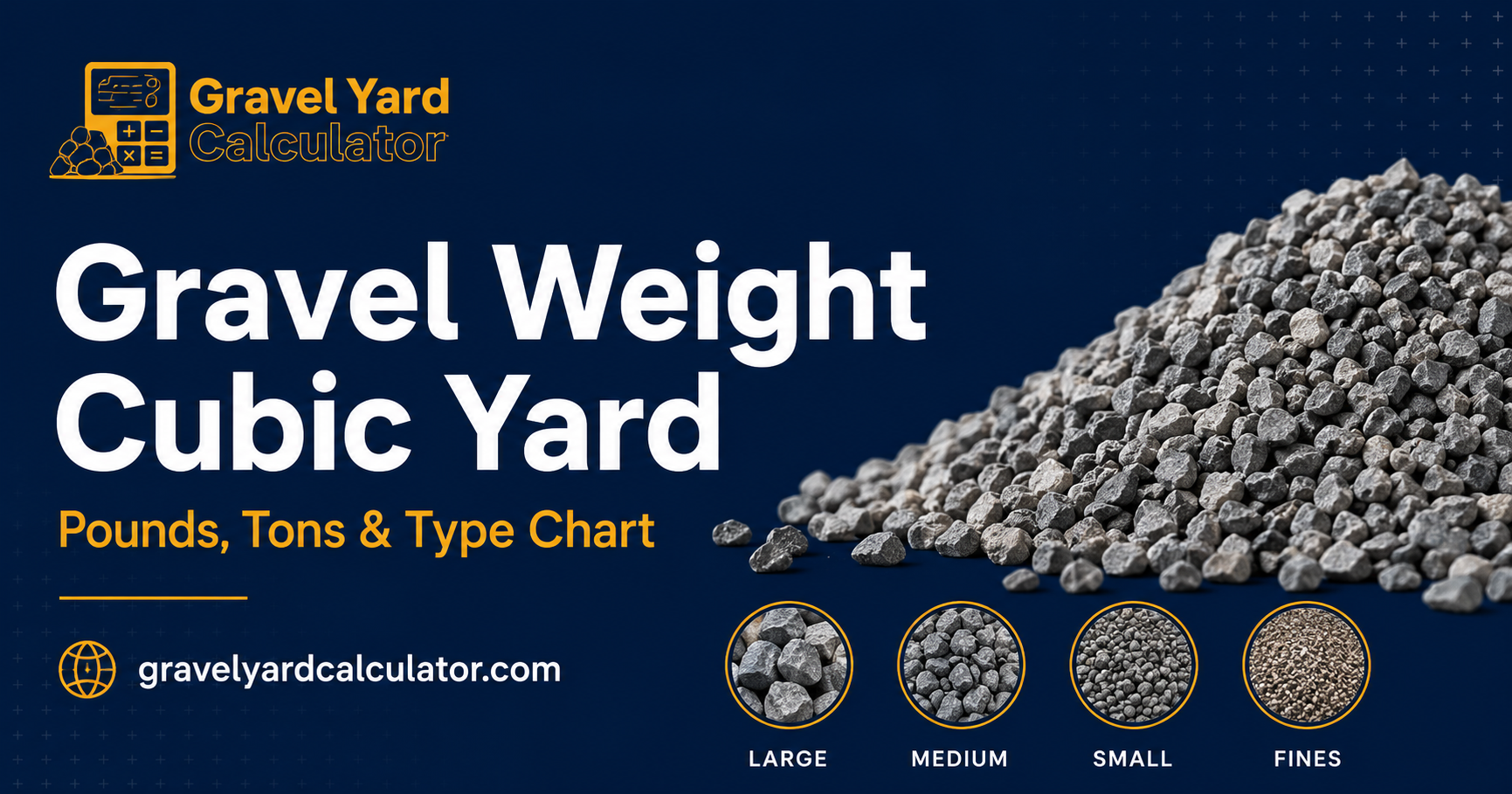
A supplier may quote gravel by the ton while your project measurements are in cubic yards. That mismatch makes ordering confusing, especially when websites show different numbers.
This gravel weight cubic yard guide gives a practical range, a material chart, and simple conversion examples. It also explains why wet, fine-rich, or compacted gravel driveway can weigh more than clean, loose stone.
Quick answer: One cubic yard of dry, loose gravel commonly weighs about 2,400 to 3,000 pounds, or 1.2 to 1.5 US tons. Wet gravel, crusher run, and compacted road base may weigh more. Use your supplier’s product density for the final order.
How Much Does a Cubic Yard of Gravel Weigh?
A cubic yard of gravel usually weighs between 2,400 and 3,000 pounds. That equals about 1.2 to 1.5 US short tons.
A range is more accurate than one fixed number because a cubic yard measures volume, not mass. Weight changes with rock type, particle size, moisture, fines, and packing condition.
Public conversion charts also show this variation. Los Angeles County lists about 2,632.5 pounds for one cubic yard of stone or gravel. Another public chart lists loose gravel near 2,565 pounds per cubic yard, with wet gravel weighing more.
Pounds and Tons per Cubic Yard
For early planning, 2,700 pounds per cubic yard is a useful middle figure for general loose gravel.
- 2,400 pounds equals 1.20 US tons.
- 2,700 pounds equals 1.35 US tons.
- 3,000 pounds equals 1.50 US tons.
NIST defines a US short ton as 2,000 pounds. A metric tonne equals 1,000 kilograms, or about 2,204.6 pounds.
Gravel Weight Cubic Yard Chart by Material Type
The gravel weight cubic yard figures below are planning ranges, not guaranteed specifications. Local product names and gradations vary, so “road base” or “3/4 minus” may describe different mixes in different areas.
|
Gravel or Aggregate Type |
Pounds per Cubic Yard |
US Tons per Cubic Yard |
Typical Condition |
|
General gravel |
2,400–3,000 lb |
1.20–1.50 tons |
Dry and loose |
|
Pea gravel |
2,400–2,800 lb |
1.20–1.40 tons |
Loose |
|
#57 gravel |
2,600–3,000 lb |
1.30–1.50 tons |
Clean and loose |
|
Crushed gravel |
2,800–3,000 lb |
1.40–1.50 tons |
Dry and loose |
|
3/4-inch clean gravel |
2,600–3,000 lb |
1.30–1.50 tons |
Washed or clean |
|
3/4-minus gravel |
2,600–3,000 lb |
1.30–1.50 tons |
Includes fines |
|
Crushed limestone |
2,400–3,000 lb |
1.20–1.50 tons |
Varies by gradation |
|
Crusher run |
2,800–3,200 lb |
1.40–1.60 tons |
Fine-rich base |
|
Road base |
2,800–3,200 lb |
1.40–1.60 tons |
Dense graded |
|
Washed gravel |
2,400–2,800 lb |
1.20–1.40 tons |
Drained and loose |
The ranges combine public conversion charts, supplier guidance, and common estimating factors. Your supplier’s measured tons-per-yard figure should replace them before ordering.
Why Gravel Weight Changes
Gravel weight changes because the same cubic-yard space can contain different amounts of stone, air, and water.
ASTM C29/C29M measures aggregate bulk density in loose or compacted conditions. Bulk density includes the spaces between particles, making it different from the density of solid rock.
Rock Type, Size, and Shape
Limestone, granite, and river stone do not weigh exactly the same. Rounded stones and angular crushed particles also leave different amounts of void space.
Fines and Gradation
Crusher run, road base, and 3/4-minus gravel contain small particles or stone dust. These fines fill spaces between larger stones and can raise the weight held within one cubic yard.
Moisture Content
Water adds mass and can fill spaces between stones. Public charts show wet gravel weighing more than dry or loose material, although the increase depends on drainage and saturation.
Loose Versus Compacted Gravel
Compaction reduces empty space. One cubic yard of compacted base can contain more material than one loose cubic yard delivered from a loader bucket.
FHWA guidance connects compaction with dry unit weight, moisture content, and compaction effort. This is why loose and compacted estimates should not be treated as identical.
How to Calculate Gravel Weight from Cubic Yards
Multiply the volume by the selected pounds-per-cubic-yard value. Then convert pounds into the unit used by your supplier.
Formulas
Total pounds = Cubic yards × Pounds per cubic yard
US tons = Total pounds ÷ 2,000
Metric tonnes = Total pounds ÷ 2,204.62
1. Find the Gravel Volume
Measure length, width, and depth in feet.
Cubic feet = Length × Width × Depth
Cubic yards = Cubic feet ÷ 27
Use the gravel calculator when you need volume, weight, and cost from project dimensions.
2. Choose the Correct Weight Factor
Use a chart figure for early planning. For the final calculation, ask whether the supplier’s value describes:
- Dry, damp, or wet gravel
- Loose or compacted material
- Clean stone or a mix containing fines
3. Multiply and Convert
Suppose you need 3 cubic yards of crushed gravel at 2,900 pounds per cubic yard.
3 × 2,900 = 8,700 pounds
8,700 ÷ 2,000 = 4.35 US tons
Do not add a compaction or waste allowance twice. Check whether your calculator or supplier already includes it.
For full area and depth calculations, see how to calculate gravel needed.
Common Gravel Weight Examples
These examples use 2,700 pounds per cubic yard. Replace that factor when the supplier gives a product-specific value.
|
Gravel Volume |
Estimated Pounds |
Estimated US Tons |
|
0.5 cubic yard |
1,350 lb |
0.675 ton |
|
1 cubic yard |
2,700 lb |
1.35 tons |
|
2 cubic yards |
5,400 lb |
2.70 tons |
|
3 cubic yards |
8,100 lb |
4.05 tons |
|
5 cubic yards |
13,500 lb |
6.75 tons |
Half Cubic Yard Gravel Weight
Half a cubic yard commonly weighs about 1,200 to 1,500 pounds when using the general dry, loose range.
Two Cubic Yards of Gravel Weight
Two cubic yards commonly weigh about 4,800 to 6,000 pounds, or 2.4 to 3 US tons.
Pea Gravel Weight per Cubic Yard
Pea gravel often falls near 1.2 to 1.4 tons per cubic yard for planning. Moisture, stone source, and packing can change the result. The pea gravel cost guide also explains common supplier pricing units.
#57 Gravel Weight per Cubic Yard
A practical range for #57 gravel is about 2,600 to 3,000 pounds per cubic yard. Clean washed #57 stone usually has fewer fines than dense-graded base.
Crusher Run and Road Base Weight
Crusher run and road base often need a higher factor because they contain fines and pack tightly. A starting range near 1.4 to 1.6 tons per cubic yard is useful, but local specifications take priority.
Cubic Yard to Metric Tonne and Cubic Meter
Metric conversion still requires a density value. Volume alone cannot provide an exact weight.
NIST lists one cubic yard as approximately 0.76 cubic meter. One metric tonne equals 1,000 kilograms.
To convert pounds into metric tonnes:
Metric tonnes = Pounds ÷ 2,204.62
For example, 2,700 pounds equals about 1.225 metric tonnes. At that example weight, the bulk density is about 1,602 kg/m³.
Which Weight Should You Use When Ordering?
Use the supplier’s conversion for the final order. Online ranges work best for planning and comparing materials.
Confirm these details before paying:
- Is the material sold by cubic yard, US ton, or metric tonne?
- Does the value describe loose or compacted material?
- Is the product clean stone or a fine-rich base mix?
- Is the stated density for dry or wet material?
- Does the supplier round to a minimum load?
For a driveway, the driveway gravel calculator can estimate volume from length, width, and depth. The supplier’s scale ticket still controls the delivered weight.
Check your vehicle’s payload rating before self-hauling. A generic online estimate should not be used as a safe load limit.
Gravel Weight FAQs
What Is the Standard Gravel Weight Cubic Yard Estimate?
There is no universal standard. A useful dry, loose range is 2,400 to 3,000 pounds per cubic yard, or 1.2 to 1.5 US tons.
How Many Pounds Are in One Cubic Yard of Gravel?
One cubic yard commonly contains about 2,400 to 3,000 pounds of dry, loose gravel. Wet or dense-graded material may weigh more.
How Many Tons Are in a Cubic Yard of Gravel?
Most general estimates fall between 1.2 and 1.5 US tons per cubic yard. Crusher run and compacted road base can be heavier.
Does Wet Gravel Weigh More Than Dry Gravel?
Yes. Water adds mass and occupies some spaces between particles. The increase depends on drainage, fines, and saturation.
Does Compacted Gravel Weigh More Than Loose Gravel?
A fixed mass does not gain weight when compacted. However, a compacted cubic yard contains more particles and fewer voids, so its unit weight is higher.
How Much Does 3/4-Inch Gravel Weigh per Cubic Yard?
A planning range of 2,600 to 3,000 pounds works for many clean products. Ask whether your local material is washed stone or 3/4 minus with fines.
Should I Order Gravel by Cubic Yard or Ton?
Use the supplier’s sales unit. Calculate project volume in cubic yards, then convert it with the supplier’s tons-per-yard factor.
Can I Use One Density for Every Gravel Type?
No. Pea gravel, #57 stone, limestone, crusher run, and washed gravel have different gradations, void spaces, and moisture conditions.
Sources and Calculation Method
The weight values in this guide are planning ranges. Unit conversions follow NIST references. Bulk-density explanations follow ASTM and FHWA guidance. Public agency charts and supplier figures were compared to avoid relying on one unsupported number.
Conclusion
Gravel has no single cubic-yard weight. Rock type, particle size, fines, moisture, and compaction all change the result. Most dry, loose material falls near 2,400 to 3,000 pounds per cubic yard, while wet or dense base products may weigh more.
Use this gravel weight cubic yard guide for early planning, then replace the general figure with your supplier’s product value. Confirm whether the quote uses US tons or metric tonnes, and check vehicle payload before hauling.
Enter your project dimensions in the calculator, compare the result with the supplier’s conversion, and order using the product-specific weight.
Disclaimer: These values are planning estimates. Actual delivered weight varies by quarry source, gradation, moisture, loading method, and compaction.