Calculation basis: U.S. figures use a 2,000-pound short ton. Metric figures use a 1,000-kilogram tonne. The coverage tables use average loose gravel density unless stated otherwise.
Quick answer: One ton of standard gravel covers about 116 square feet at 2 inches deep, 77 square feet at 3 inches, or 58 square feet at 4 inches. Actual coverage changes with gravel type, moisture, compaction, and supplier density. Check the product’s weight per cubic yard before placing a large order.
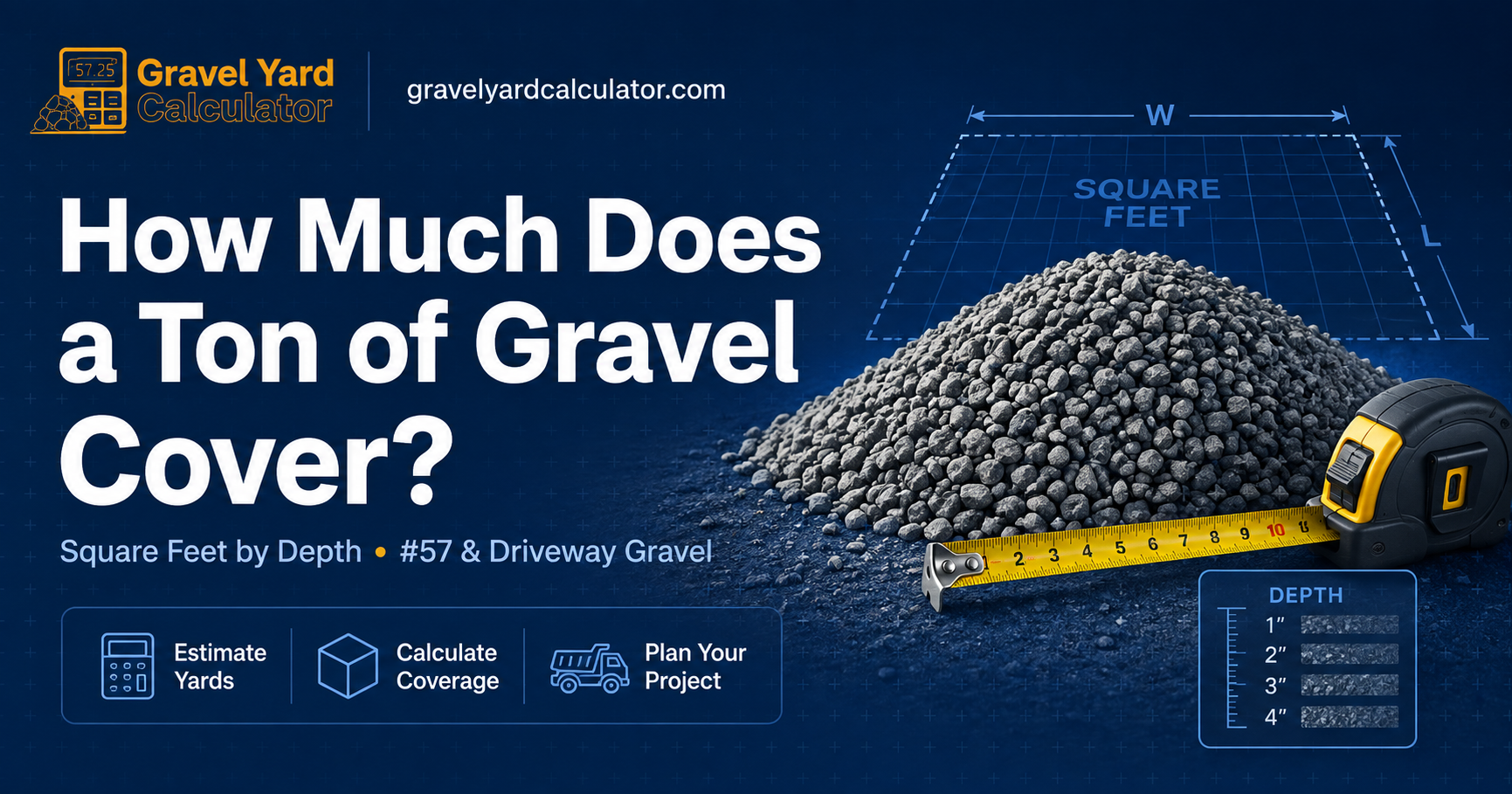
If you are asking how much does a ton of gravel cover, depth matters more than any other measurement. A thin layer spreads across a wide area, while a driveway base uses the same ton in a much smaller space.
This guide gives square-foot and square-metre coverage tables, a formula you can reuse, and estimates for pea gravel, #57 stone, crushed gravel, ¾-inch gravel, bulk bags, and multiple-ton orders. For a project-specific result, enter your measurements in the gravel calculator and compare the total with your supplier’s density.
How Much Does a Ton of Gravel Cover at Different Depths?
A practical estimate is 100 to 120 square feet at 2 inches deep. At 4 inches deep, expect about 50 to 60 square feet. The table below uses standard gravel weighing 1.4 short tons per cubic yard.
|
Gravel depth |
Coverage from 1 ton |
|
1 inch |
About 231 sq ft |
|
2 inches |
About 116 sq ft |
|
3 inches |
About 77 sq ft |
|
4 inches |
About 58 sq ft |
|
6 inches |
About 39 sq ft |
|
8 inches |
About 29 sq ft |
These figures are planning estimates, not guaranteed delivery coverage. A lighter, dry product occupies more volume per ton and covers more ground. Dense, wet, or compacted material occupies less volume and covers less.
The National Institute of Standards and Technology defines one cubic yard as 27 cubic feet. It also treats an unmodified U.S. ton as 2,000 pounds. Those fixed units make the calculation reliable, but the gravel’s bulk density still changes the answer.
Why Gravel Coverage per Ton Changes
The same weight does not always fill the same volume. Gravel coverage per ton changes for five main reasons:
- Layer depth: Doubling the depth cuts the covered area in half.
- Material density: Dense crushed stone covers less area per ton than lighter gravel.
- Moisture: Water adds weight without adding the same amount of stone volume.
- Grading and stone size: A mix with fines may pack into smaller voids than clean, open-graded stone.
- Compaction and site condition: Ruts, low spots, soft ground, and mechanical compaction can increase the amount needed.
This is why one fixed answer cannot fit pea gravel, #57 stone, 2B stone, 20mm gravel, and every ⅜-inch, ½-inch, or ¾-inch product. Product names and gradations can also change between regions and suppliers. Ask for the supplier’s loose bulk weight or gravel weight per cubic yard before converting volume into tons.
Gravel Coverage Formula
To answer how much does a ton of gravel cover for a specific product, use this formula when your supplier gives density in tons per cubic yard:
Coverage in square feet = 324 × number of tons ÷ (tons per cubic yard × depth in inches)
For one ton of gravel at 1.4 tons per cubic yard and a 2-inch depth:
324 × 1 ÷ (1.4 × 2) = 115.7 square feet
Rounded for ordering, that is about 116 square feet.
You can also work from project dimensions:
- Multiply length by width to find square feet.
- Divide the planned depth in inches by 12.
- Multiply the area by depth in feet to find cubic feet.
- Divide cubic feet by 27 to find cubic yards.
- Multiply cubic yards by the supplier’s tons-per-yard figure.
Keep the base calculation separate from any waste or compaction allowance. This prevents you from adding the same extra percentage twice.
Coverage by Gravel Type
Material type affects how much area a ton covers because each product has a different loose bulk density. The figures below use common planning ranges. Supplier data should replace them when available.
|
Gravel type |
Planning density |
Coverage at 2 inches |
Coverage at 4 inches |
|
Pea gravel |
1.3 tons/yd³ |
About 125 sq ft |
About 62 sq ft |
|
#57 gravel |
1.4 tons/yd³ |
About 116 sq ft |
About 58 sq ft |
|
¾-inch crushed gravel |
1.4–1.5 tons/yd³ |
About 108–116 sq ft |
About 54–58 sq ft |
|
Crushed stone |
1.5 tons/yd³ |
About 108 sq ft |
About 54 sq ft |
How Much Does a Ton of Pea Gravel Cover?
One ton of pea gravel covers about 125 square feet at 2 inches deep or 62 square feet at 4 inches, based on 1.3 tons per cubic yard.
Rounded pea gravel does not lock together like angular crushed stone, so edging and finished depth matter. Use the pea gravel calculator for circles, paths, patios, and bag estimates.
What About #57, 2B, 20mm, and ¾-Inch Gravel?
A ton of #57 or ¾-inch gravel often covers around 108 to 116 square feet at 2 inches deep.
The terms #57, 2B, and 20mm may describe similar size ranges in different markets, but gradation and source still affect bulk weight. Do not choose a density from the product name alone.
How Much Do Multiple Tons of Gravel Cover?
When you need to compare several load sizes, how much does a ton of gravel cover becomes the starting point. The following table uses 1.4 tons per cubic yard. Multiply or divide these values when your order falls between the listed amounts.
|
Gravel amount |
At 2 inches |
At 3 inches |
At 4 inches |
|
½ ton |
58 sq ft |
39 sq ft |
29 sq ft |
|
1 ton |
116 sq ft |
77 sq ft |
58 sq ft |
|
2 tons |
231 sq ft |
154 sq ft |
116 sq ft |
|
3 tons |
347 sq ft |
231 sq ft |
174 sq ft |
|
4 tons |
463 sq ft |
309 sq ft |
231 sq ft |
|
5 tons |
579 sq ft |
386 sq ft |
289 sq ft |
|
10 tons |
1,157 sq ft |
771 sq ft |
579 sq ft |
|
15 tons |
1,736 sq ft |
1,157 sq ft |
868 sq ft |
|
20 tons |
2,314 sq ft |
1,543 sq ft |
1,157 sq ft |
For example, two tons spread 3 inches deep cover about 154 square feet. If the gravel weighs 1.5 tons per cubic yard instead, the same order covers about 144 square feet.
How Much Does a Tonne of Gravel Cover in Square Metres?
When UK buyers ask how much does a ton of gravel cover, they usually need metric-tonne figures. A metric tonne equals 1,000 kilograms. Using a planning bulk density of 1,650 kg/m³, one tonne occupies about 0.61 cubic metre.
|
Gravel depth |
Coverage from 1 metric tonne |
|
25mm |
About 24.2 m² |
|
40mm |
About 15.2 m² |
|
50mm |
About 12.1 m² |
|
75mm |
About 8.1 m² |
|
100mm |
About 6.1 m² |
Use this metric formula:
Coverage in m² = weight in kg ÷ (bulk density in kg/m³ × depth in metres)
A bag described as a bulk or tonne bag may not contain exactly 1,000 kilograms. Read the stated weight before calculating.
For example, an 800kg bag provides 80% of the coverage shown above. It would cover about 9.7 m² at 50mm using the same density.
How Much Driveway Does a Ton of Gravel Cover?
For a single 4-inch layer, one ton of standard gravel covers about 58 square feet. A driveway measuring 10 feet wide would receive roughly 5.8 linear feet of coverage from that ton.
A new driveway may need separate sub-base, base, and surface layers rather than one uniform layer. Soil strength, drainage, traffic, slope, and local requirements can change the design. Use the driveway gravel calculator for the material estimate, then confirm the layer plan before ordering.
Do not treat a thin resurfacing layer as a full driveway base. One ton may spread farther during a top-up, but it will not fix soft ground, deep ruts, or drainage failure.
Should You Add Extra Gravel?
Add extra only after calculating the measured volume. A 5% to 10% allowance can help cover small low spots, spreading loss, settlement, and supplier rounding on a straightforward residential job. Uneven excavation or structural base work may need a different allowance.
Compaction and waste are not the same. Compaction reduces voids in the placed aggregate, while waste covers material lost or left during handling. Federal Highway Administration guidance treats moisture and density as key parts of aggregate compaction, so a fixed percentage cannot replace site checks.
Before ordering:
- Confirm the finished depth.
- Ask the supplier for tons per cubic yard or kg/m³.
- Check whether the quote uses a short ton, long ton, or metric tonne.
- Verify the actual weight of any bulk bag.
- Round up to the supplier’s available sales unit.
Frequently Asked Questions
How Much Does a Ton of Gravel Cover at 2 Inches Deep?
Standard gravel covers about 116 square feet at 2 inches using a density of 1.4 tons per cubic yard. A practical range is about 95 to 135 square feet for gravel weighing 1.2 to 1.7 tons per cubic yard.
How Far Does One Ton of Gravel Spread at 3 Inches Deep?
One ton spreads across about 77 square feet at 3 inches deep using the standard 1.4-ton density. Lighter pea gravel may cover slightly more, while dense or wet crushed stone may cover less.
How Many Square Feet Does a Ton of Gravel Cover at 4 Inches?
It covers about 58 square feet at 4 inches deep under the standard assumption. Across a 10-foot-wide area, that equals about 5.8 linear feet.
How Many Cubic Yards Are in a Ton of Gravel?
At 1.4 tons per cubic yard, one ton equals about 0.71 cubic yard, or roughly 19.3 cubic feet. Depending on gravel density, one ton may occupy about 0.59 to 0.83 cubic yard.
How Much Does a One-Ton Bag of Gravel Cover?
A true one-ton bag follows the same depth chart as loose gravel of the same density. Check the bag’s stated weight because some bags contain less than one short ton or metric tonne.
Does Compacted Gravel Cover Less Than Loose Gravel?
Yes, when measured by delivered weight. Compaction reduces air voids and lowers the finished volume, so the installed layer may cover less area than a loose-volume estimate suggests.
What Is the Fastest Way to Estimate Gravel Coverage?
Use area, finished depth, and product density rather than relying on tonnage alone. A calculator can convert those inputs into cubic yards, tons, and cost while keeping the weight and volume steps separate.
Plan Your Gravel Order With the Right Depth and Density
The answer to how much does a ton of gravel cover depends on depth and bulk density. As a useful starting point, expect about 116 square feet at 2 inches, 77 square feet at 3 inches, or 58 square feet at 4 inches for standard gravel.
Check three details before buying: the finished depth, the supplier’s weight per cubic yard, and whether the order uses a U.S. short ton or metric tonne. Then add a site-based allowance and round to the available delivery unit.
Use the calculator for your exact dimensions before requesting the final quote.